Gargoyle geckoRhacodactylus auriculatus
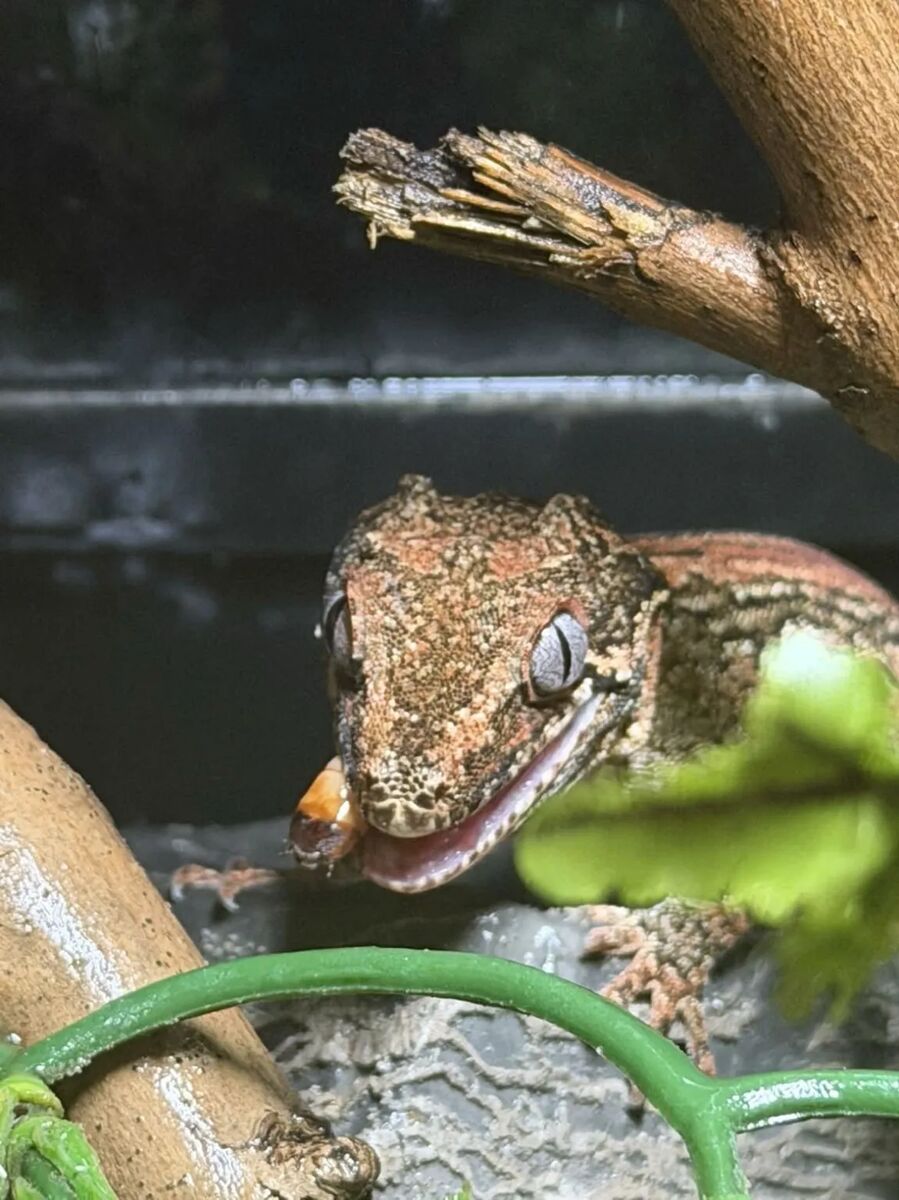
Gargoyle geckos come from southern New Caledonia and are named for the knobbly bumps on their heads. They're sturdy, handleable and a little more of a predator than crested geckos. Our oldest resident, Lucifer, is one.
Enclosure
Adults need at least 45 × 45 × 90 cm (18 × 18 × 36 in). Bigger is always better.
Never house males together, or geckos of different sizes: gargoyles will bite tails and larger geckos may eat smaller ones.
Heating
Keep a basking area around 29°C (84°F) with shade air of 25–29°C and a cooler zone at 22–23°C. Night can drop to 20–25°C.
Air should never go above 30°C (86°F). Use a thermostat and a digital thermometer.
Lighting & UVB
Provide low-level UVB (UVI 1.0–2.0 at the basking branch) on a 12-hour day. No light at night.
Humidity & water
Average humidity of 50–70%. Mist heavily in the evening and lightly in the morning, then let the enclosure dry to around 50% between mistings.
Provide a dish of fresh water.
Substrate & decor
Use a moisture-holding soil-based substrate or a bioactive setup, with plenty of branches, cork and foliage for climbing and cover.
Diet & feeding
Feed a complete powdered gecko diet as the staple. Juveniles: diet daily and insects every other day. Adults: diet every other day and insects twice a week.
Insects are a must for gargoyles. Offer crickets, dubia roaches, black soldier fly larvae or silkworms, no wider than the space between the eyes. Gutload them for 24 hours first.
Skipping a feed a few times a month helps prevent obesity.
Supplements
Dust all insects with calcium: without D3 if you use UVB, with D3 if you don't.
Handling
Usually mellow and handleable once settled. Support the body and let them walk hand to hand.
Unlike crested geckos, gargoyles can drop their tail and regrow it, though the new tail looks different.
Health watch
Watch for bite wounds or tail damage if housed together, retained shed, weight loss and obesity.
Every animal is an individual. Use this sheet as a starting point, measure temperatures and UVB properly, and speak to an exotic vet about any health concerns.
Last updated October 2026. Care guidance is subject to change as husbandry research develops.