Casque-headed iguanaLaemanctus spp.
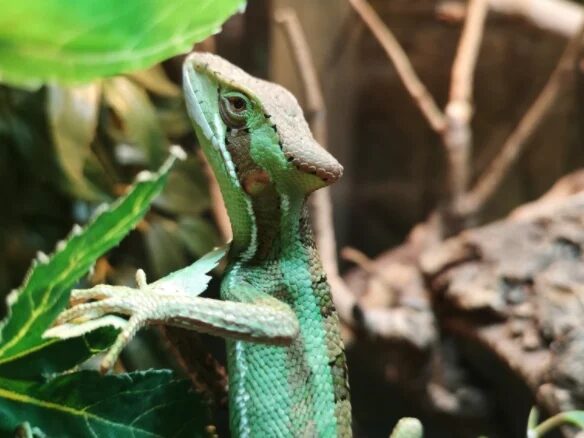
Casque-headed iguanas are slim, tree-dwelling lizards from the forests of Mexico and Central America, named for the flat crest on the back of the head. Despite the name they're insect-eaters, not plant-eaters like green iguanas. Our resident Ivy is one.
Enclosure
At least 90 × 45 × 90 cm, taller and larger where possible, with lots of branches, vines and dense planting. They rest on branches rather than in hides, so a thick, leafy 'off-show' area helps them feel secure.
Keep one per enclosure.
Heating
Provide a deep hot spot of 32–35°C at the top, with the rest of the enclosure at 22–25°C. Nights can drop to around 18°C. Use a thermostat.
Lighting & UVB
Good UVB is essential: aim for a UVI of 3–4 at the highest basking branch, for example a T5 6% tube 30–40 cm away or a 12% tube 40–60 cm away. Run lights for about 12 hours.
Humidity & water
Keep humidity high, around 70–90%, with good ventilation so it doesn't go stale. Dehydration is a common problem: mist daily and consider a dripper or running water feature, as they prefer drinking moving droplets.
Diet & feeding
Casque-headed iguanas are insectivores. Feed a variety of gutloaded insects such as crickets, locusts and roaches, with silkworms, snails and earthworms as moisture-rich extras. Waxworms and other fatty grubs are treats only.
Supplements
Dust insects with calcium and a multivitamin. Ask an exotic vet or experienced keeper for a schedule if you're unsure.
Handling
They're quick and delicate, so handling isn't recommended at first. Some become calmer with time and patience; tong-feeding is the best way to build trust.
Health watch
Dehydration, stress from too little cover, and metabolic bone disease from poor UVB.
Every animal is an individual. Use this sheet as a starting point, measure temperatures and UVB properly, and speak to an exotic vet about any health concerns.
Last updated October 2026. Care guidance is subject to change as husbandry research develops.