Bearded dragonPogona vitticeps
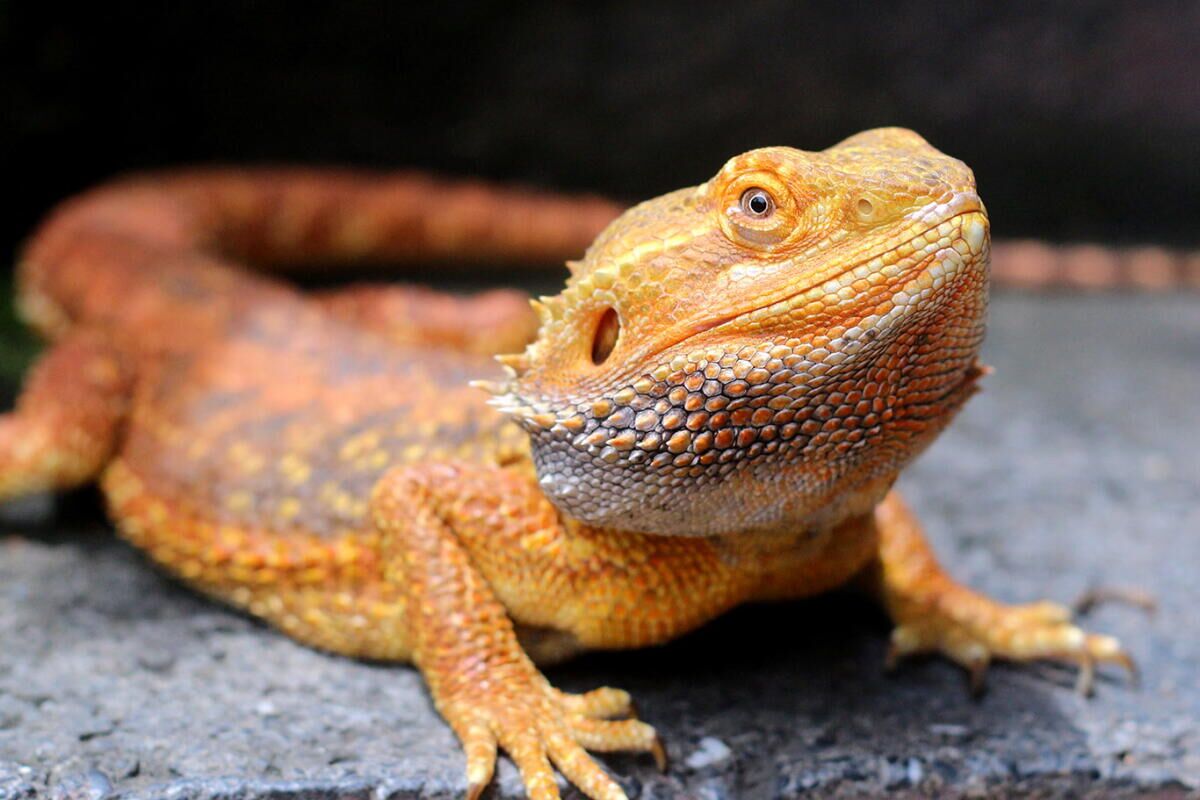
Central bearded dragons come from the semi-arid scrub and dry woodland of eastern and central Australia. They're curious and handleable, but need a large enclosure, intense heat and strong UVB.
Enclosure
Adults need at least 180 × 60 × 60 cm (6 × 2 × 2 ft). Smaller adults under about 45 cm long can manage in 120 × 60 × 60 cm.
Keep one dragon per enclosure. Males fight, males and females will breed, and adults can injure juveniles.
Heating
Bearded dragons need a hot basking surface of 42–45°C, falling to 25–29°C at the cool end, so they can thermoregulate.
Use halogen flood bulbs on a dimming thermostat. Turn heat off at night: drops to 12–24°C are normal.
Lighting & UVB
Strong UVB is essential: a T5 HO 12% or 14% tube giving a UVI of 4.0–4.5 at the basking spot, falling towards 0 at the far end. No glass or plastic between bulb and dragon.
Replace T5 tubes every 12 months. Follow a daylight cycle of roughly 14 hours in summer and 10 in winter.
Humidity & water
Keep average humidity at 30–60%, measured at the cool end.
Offer a shallow water dish. Misting greens is a good way to add moisture.
Substrate & decor
A deep, dig-friendly substrate (such as a soil and sand mix) works well; plain sand is fine if it's deep and dampened to form a crust.
Include a large basking platform, rocks, branches to climb and somewhere to hide.
Diet & feeding
Hatchlings: insects and greens daily. Juveniles: 5–6 head-sized insects daily plus greens. Adults: 3–4 insects twice a week, with salad about three times a week.
Good greens: spring greens, collard, turnip and mustard greens, rocket, watercress, kale, cactus pad. Fruit is a rare treat.
Never feed avocado, onion or mushrooms, or wild-caught insects.
Supplements
Lightly dust insects and salads with calcium. Add a multivitamin once a week for adults and twice a week for juveniles.
Handling
Usually calm and tolerant. Support the whole body and limbs, and let them settle before handling after a meal.
Health watch
Metabolic bone disease (from poor UVB or calcium), impaction, parasites, mouth rot and yellow fungus are the big ones. Beardies also brumate in winter, so get a vet check if appetite drops.
Every animal is an individual. Use this sheet as a starting point, measure temperatures and UVB properly, and speak to an exotic vet about any health concerns.
Last updated October 2026. Care guidance is subject to change as husbandry research develops.